Tag Archives: food

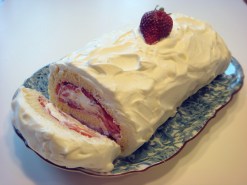
Strawberries & Cream Sponge Cake Roll

As I mentioned yesterday, this is one of my very favorite cakes. I have been baking it since I was in high school. Back then, my main sources of recipe inspiration (in addition to a wonderful mother from whom I am still inspired) were two Southern Living Annual Cookbooks. From the 80s. I have adapted this recipe somewhat from the original recipe (and often make it sugar-free and whole grain), and I still love it just as much now as I did then.

This cake is light, full of fruit, and not overly sweet. I love whipped cream as a frosting because you can easily control how sweet it is without compromising texture. This is also a cake that is easy to make healthier with some simple substitutions (see recipe at end of post). By substituting a gluten free flour (oats, brown rice, etc) this is easily made gluten free as well.

A sponge cake is made mostly of eggs with just enough flour to stabilize it, and just enough sugar that it doesn’t taste like an omelet.

Roll cakes look much more complicated than they really are, so for those who may not be familiar with baking and putting together this kind of cake, I have included a few more process pictures. This technique can also be used to make jelly-rolls, pumpkin roll cakes (another of my favorites!), Christmas Yule logs, ice-cream filled roll cakes.

The one thing that my kids don’t like about this cake is that the beaters are no fun to lick! Large amounts of raw eggs, no matter how much they’ve been whipped and what other ingredients have been thrown in, still taste pretty bad. Luckily, something magical happens in the oven, leaving you with a moist, airy cake just begging for a creamy, fruity filling.

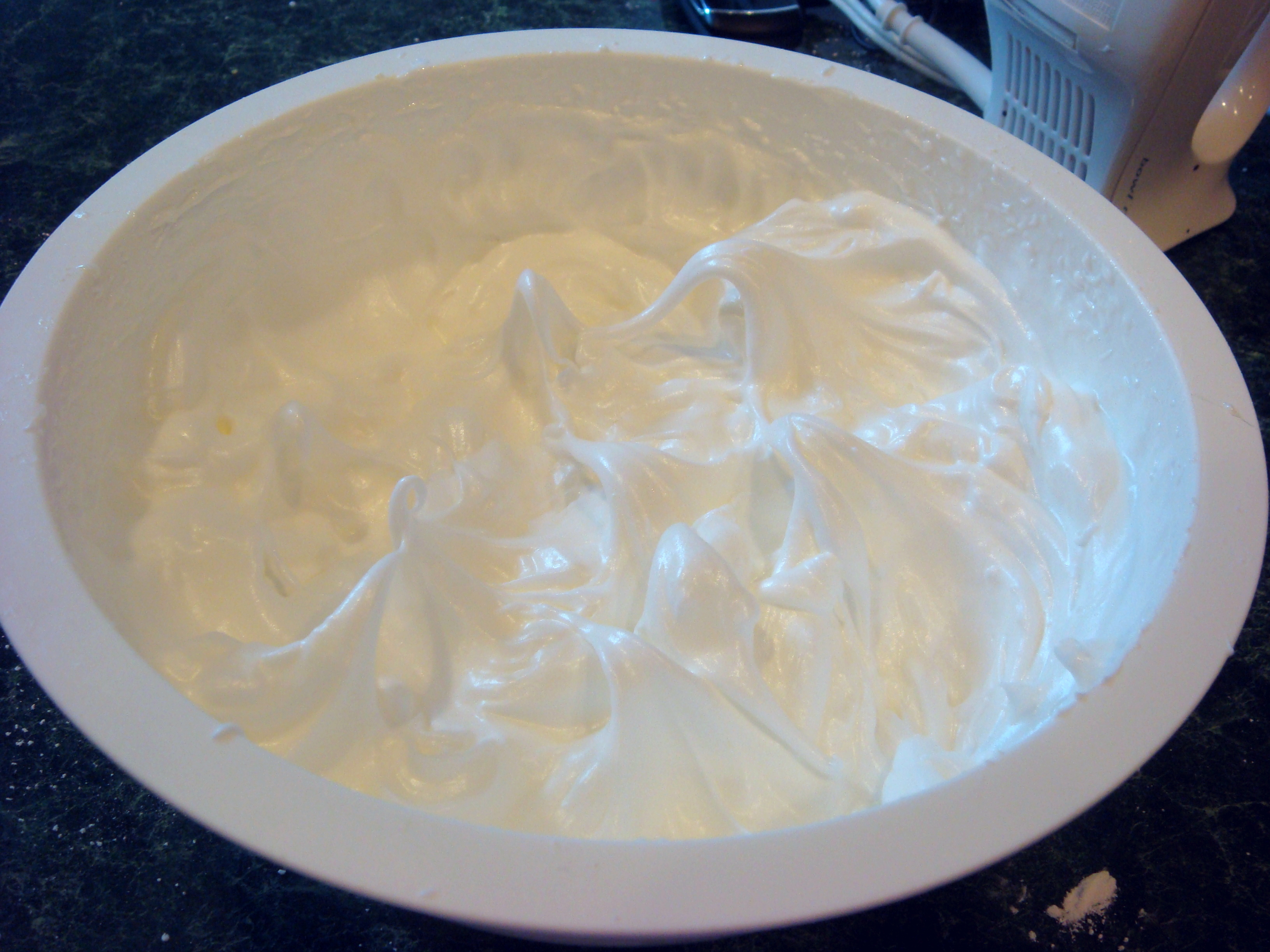
Start by beating 5 egg whites until stiff peaks form (with a little salt and cream of tartar-for stabilization). You should be able to turn your bowl upside down and have the egg whites not run onto the counter (just be careful testing this as you go along!)
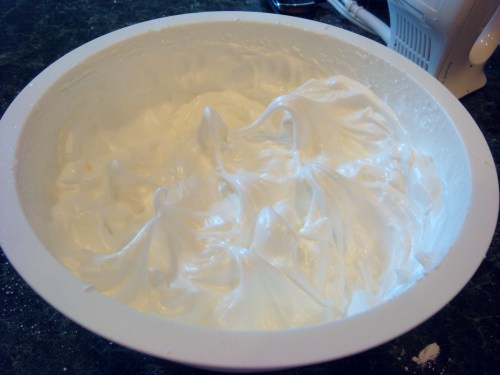
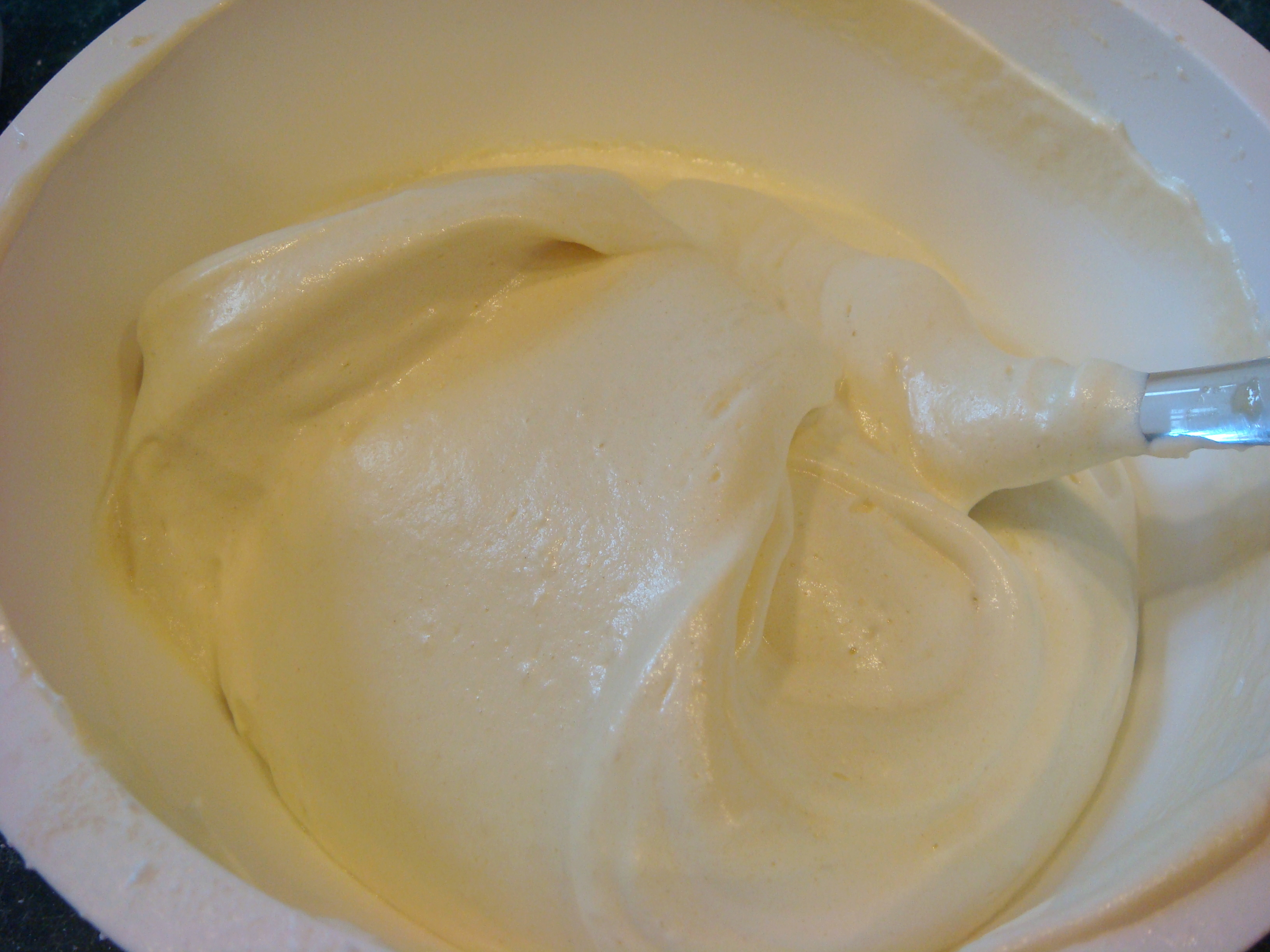
Beat your egg yolks separately, then gently fold them into the egg whites with a little flour and powdered sugar. This is one cake that I do sift my powdered sugar and flour for. It makes a huge difference in being able to incorporate them quickly into the batter without lumps. I measure first, then sift them directly into the egg white bowl.

The batter should still be pretty thick when you are done, but will lose a little of the  volume.

Use wax paper to line a jelly-roll pan (baking pan that is about 10×15”, but you can use a size that is a little larger as well; 9×13” is too small). Leave some hanging over the edges. Spray the wax paper with baking spray (I use the kind for baking that has flour in it).

Spread your batter into the pan, making sure to spread it all the way to the edges. This batter will not melt or spread as it cooks, so try to get it even on the top.

Bake for 10-12 minutes, or until set. It should not brown. The cake below is actually just a little overdone (it still tasted great though!)

While the cake is baking lay a linen (or fuzz-free) dishtowel on the counter. Dust a small amount of powdered sugar onto the towel in a rectangle just larger than your baking pan (I use a sifter again-actually just a mesh strainer). Turn the hot cake upside down onto the towel (wax paper side up). Gently peel off the waxed paper.

Roll the cake up in the towel, beginning at the narrow end.

Cool completely on a rack.

Unroll cooled cake (leave on towel) and spread with sliced fruit. This is one quart of sliced strawberries mixed with 2 Tbs sugar. I like to let the fruit/sugar mixture sit for a few minutes before spreading it onto the cake so that the sugar dissolves.
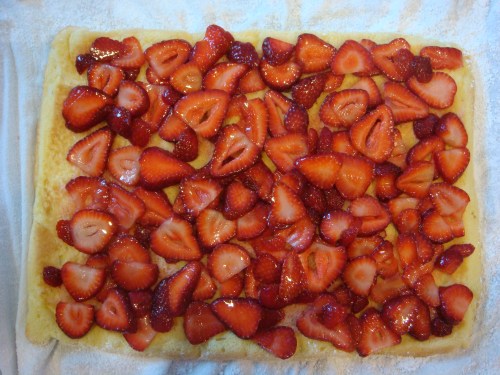
Beat 2 cups of whipped cream until stiff. Sweeten to taste. Spread half of the whipped cream over the berries, until the berries are just barely covered. Leave a small section on one of the narrow ends uncovered. As you roll the cake, some of the filling will push to the end. This keeps too much from leaking out.

Beginning at the narrow end, roll cake again. Place on a serving platter, seam side down.

Frost with remaining whipped cream. Garnish with whole strawberries, if desired.

Slice and serve. Store in the refrigerator.

You could make this with different kinds of fruit; fresh berries work especially well.

Another use for the cake: Bake as directed and let cool without rolling. Cut cake into small squares and use as a base for an English Trifle.

RECIPE:

Strawberries and Cream Sponge Cake Roll
5 egg yolks
1 tsp vanilla
5 egg whites
½ tsp cream of tartar
¼ tsp salt
¾ cup sifted powdered sugar
½ cup flour
Powdered Sugar
1 quart strawberries, sliced
2 Tbs sugar
2 cups whipping/heavy cream
½ tsp vanilla
2-3 Tbs powdered sugar
Whole strawberries for garnish

Preheat oven to 350°F. Line a 15×10” jellyroll pan (or cookie sheet with sides) with wax paper and spray with cooking spray (Cooking spray w/flour in it for baking works great).

Beat egg yolks until light and lemon colored. Stir in vanilla. Beat egg whites until foamy. Add cream of tartar and salt, beating until stiff. Fold in ¾ cup powdered sugar. Fold in egg yolk mixture. Fold in flour. Spread batter in pan. Bake at 350°F for 10-12 minutes (do not let cake brown).

Using a fine mesh strainer, sift a small amount of powdered sugar on a linen towel. Turn hot cake out onto towel. Carefully peel off waxed paper. Roll up cake in the towel. Cool on a wire rack.

Combine strawberries and 2 Tbs sugar; let sit for 5 minutes. Beat whipping cream until foamy. Add 2-3 Tbs powdered sugar and ½ tsp vanilla, beating until soft peaks form. Unroll cake. Spread cake with berries, then half of the whipped cream. Reroll cake. Place on a serving plate. Frost with remaining whipped cream. Garnish with whole strawberries. Chill until serving time.

Sugar Free/Whole Grain/Gluten Free Alternative: Substitute Stevia, Splenda, or erythritol for the sugar (use Splenda or erythritol in the cake; stevia does not provide the bulk the cake needs, but is fine for sweetening the filling), and oat flour, rice flour or finely ground whole wheat flour (white wheat, preferably) for the white flour. The whole wheat flour obviously isn’t gluten free, but you can substitute most other gluten free flours, or a blend of flours for the white flour.

NoEmptyChairs.me

4 Comments

Filed under Desserts

Happy Birthday

This weekend marks two milestone birthdays around here. One year ago, I started this humble little blog. That weekend also happened to be my 39th birthday. I will leave it to you mathematicians to figure out how old that makes me today. From here on out I think I will start counting my age in blog-years instead of actual years since my birth.

Since I started blogging a year ago, there are 2 questions that I get asked a lot. Why did I decide to start a blog? and Why did I name my blog “No Empty Chairs”?

With a growing family of 7 competing for computer time on one home computer, I don’t usually get much time to just “surf the net”. I usually have a specific purpose for using the computer. One day several years ago, I was looking for a recipe for a specific dish. And I came across my very first food blog (Kalyn’s Kitchen). A whole new world opened up to me that day! I had no idea there were so many people out there writing about food. I was instantly hooked. I followed links to find other great food blogs. I set up an iGoogle home page so that I could follow RSS feeds, and know when my favorite bloggers posted new recipes. I rarely commented, but loved the wealth of information and new recipes to try. I bookmarked (and cooked) tons of new recipes.

Until last year, starting my own blog was something that I thought about, but only as a far off dream. After all-I have no photographic skills or equipment; no real culinary training; I’m a math geek not a creative writer; and I felt like I had no time to really call my own, especially with little kids still home all day, big kids with their own schedules later in the day, and a full-time responsibility at church. But I did love to cook; still love to cook.

Cooking and mealtimes have always meant so much more to me than just filling a physical need for nourishment. Food and meals (and of course treats!) are a way of connecting as family and friends, a way to share both happiness and tragedy, and a vehicle for showing love and gratitude. Family mealtime, dinner in particular, is one family tradition that I have always been adamant about. I learn more about my children at family meals than at any other time during the day. And what better way to entice your children to sit and talk than to provide them with foods they love (okay-they rarely ALL love every item in every meal, but it is getting a little better as they get a little older).

For years I have collected and organized in various ways our “Family Recipes”, the food that our family loves to eat. Some are new recipes found in cookbooks or magazines (or blogs!) and some are treasured favorites from family and friends. Some are things that I have created myself. I had always planned to find the “perfect” way to pass these on to my children as part of their connection to their past, something like a family cookbook. Blogging is my newest attempt at creating that lasting link for them. One that can continue to grow.

So about a year and a half ago, I started to find myself thinking about blogging more and more. Composing posts in my head as I cooked, or planned meals. Lying awake in bed at night wondering what I would call a blog. And then usually dismissing all of those thoughts with doubts and reasons why I would never really do it- lack of time, lack of skills: both photographically and computer/technology related.

Which brought me to my 39th birthday.  A perfect time for reflection and self-analysis. And maybe just a little bit of panic! Our family was gathered around the TV in the family room watching the General Conference broadcast from our church. Elder Henry B. Eyring of the Quorum of the Twelve Apostles was speaking. His talk was on the perfect example of Jesus Christ, and ways that we should pattern our lives after Him. He talked about a gravestone near his home with the inscription, “Please, no empty chairs”. As he spoke about this woman’s desire for her family to be together throughout eternity, a great overwhelming feeling came to me that this is exactly what I want as well. I want no empty chairs at my eternal table. So I will start with No Empty Chairs at my kitchen table. I want my family (and friends and neighbors) to WANT to sit around my table. To share life, with all of its joys and trials, as we share the nourishment and joy of food.

And so I invite you to fill a chair at our table, as I share the food that feeds both the body and soul in our home and helps cement bonds of family unity and friendship. Welcome to No Empty Chairs. I’ve saved you a seat.

No Empty Chairs Signature2

For those of you who have dragged yourselves through such a long-winded post, I share my favorite birthday cake:

Strawberries and Cream Sponge Cake Roll

5 egg yolks
1 tsp vanilla
5 egg whites
½ tsp cream of tartar
¼ tsp salt
¾ cup sifted powdered sugar
½ cup flour

Powdered Sugar

1 quart strawberries, sliced
2 Tbs sugar
2 cups whipping/heavy cream
½ tsp vanilla
2-3 Tbs powdered sugar
Whole strawberries for garnish

Preheat oven to 350°F. Line a 15×10” jellyroll pan (or cookie sheet with sides) with wax paper and spray with cooking spray (Cooking spray w/flour in it for baking works great).

Beat egg yolks until light and lemon colored. Stir in vanilla. Beat egg whites until foamy. Add cream of tartar and salt, beating until stiff. Fold in ¾ cup powdered sugar. Fold in egg yolk mixture. Fold in flour. Spread batter in pan. Bake at 350°F for 10-12 minutes (do not let cake brown).

Using a fine mesh strainer, sift a small amount of powdered sugar on a linen towel. Turn hot cake out onto towel. Carefully peel off waxed paper. Roll up cake in the towel. Cool on a wire rack.

Combine strawberries and 2 Tbs sugar; let sit for 5 minutes. Beat whipping cream until foamy. Add 2-3 Tbs powdered sugar and ½ tsp vanilla, beating until soft peaks form. Unroll cake. Spread cake with berries, then half of the whipped cream. Reroll cake. Place on a serving plate. Frost with remaining whipped cream. Garnish with whole strawberries. Chill until serving time.

Sugar Free/Whole Grain Alternative: Substitute Stevia, Splenda, or erythritol for the sugar (use Splenda or erythritol in the cake; stevia does not provide the bulk the cake needs, but is fine for sweetening the filling), and oat flour, rice flour or finely ground whole wheat flour (white wheat, preferably) for the white flour. The whole wheat flour obviously isn’t gluten free, but you can substitute most other gluten free flours, or a blend of flours for the white flour.

NoEmptyChairs.me

__

For detailed cake prep pictures and directions, see THIS POST


3 Comments

Filed under Desserts, Uncategorized

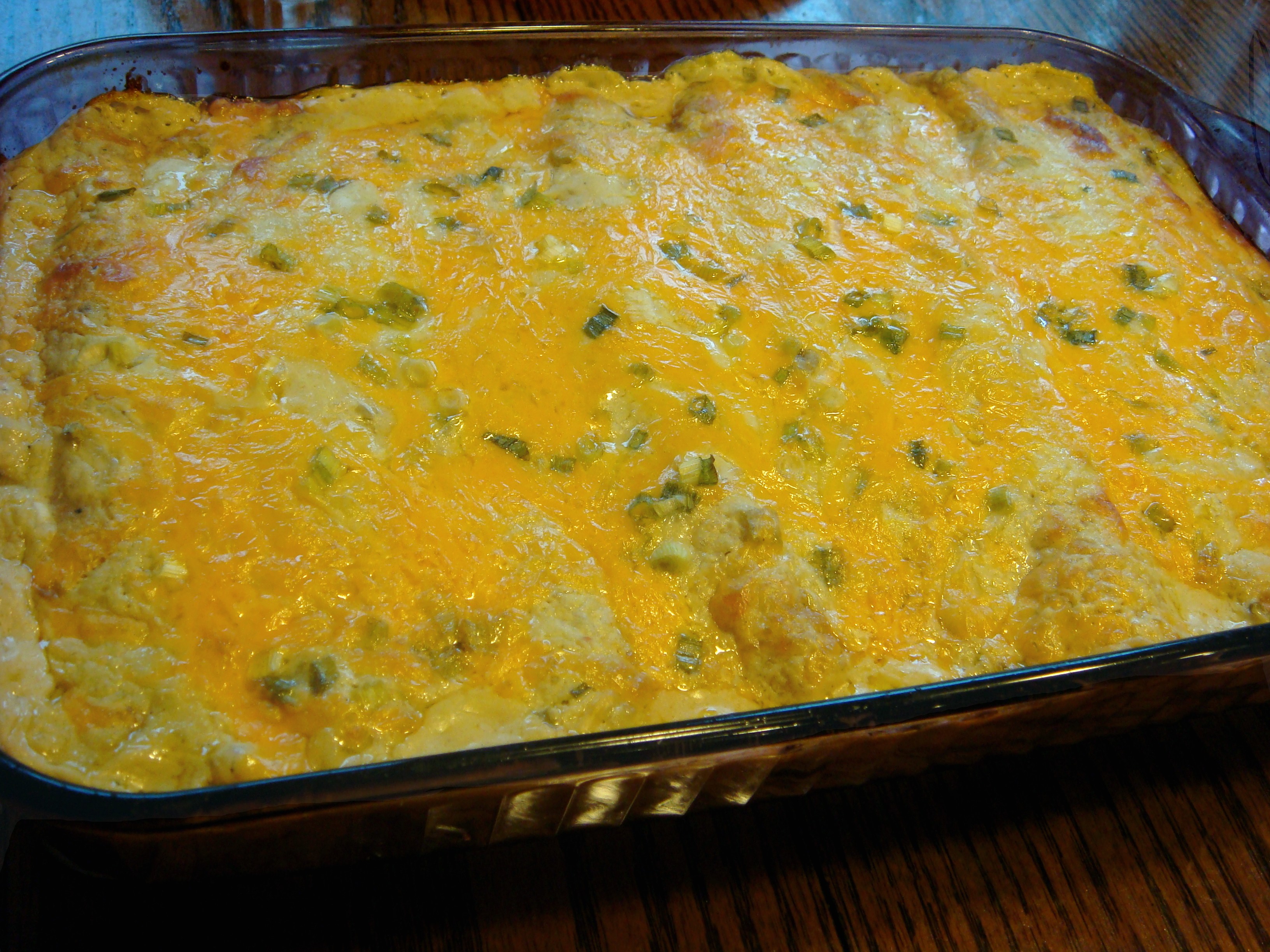
Creamy Chicken Enchiladas Verdes

This is one of those recipes for which I very rarely measure ingredients. The recipe below includes specific amounts, but feel free to just use these as guidelines. I usually use chicken that I have prepared another day (for shredding chicken in a crockpot, see this other recipe for enchiladas) and frozen in Ziploc bags.

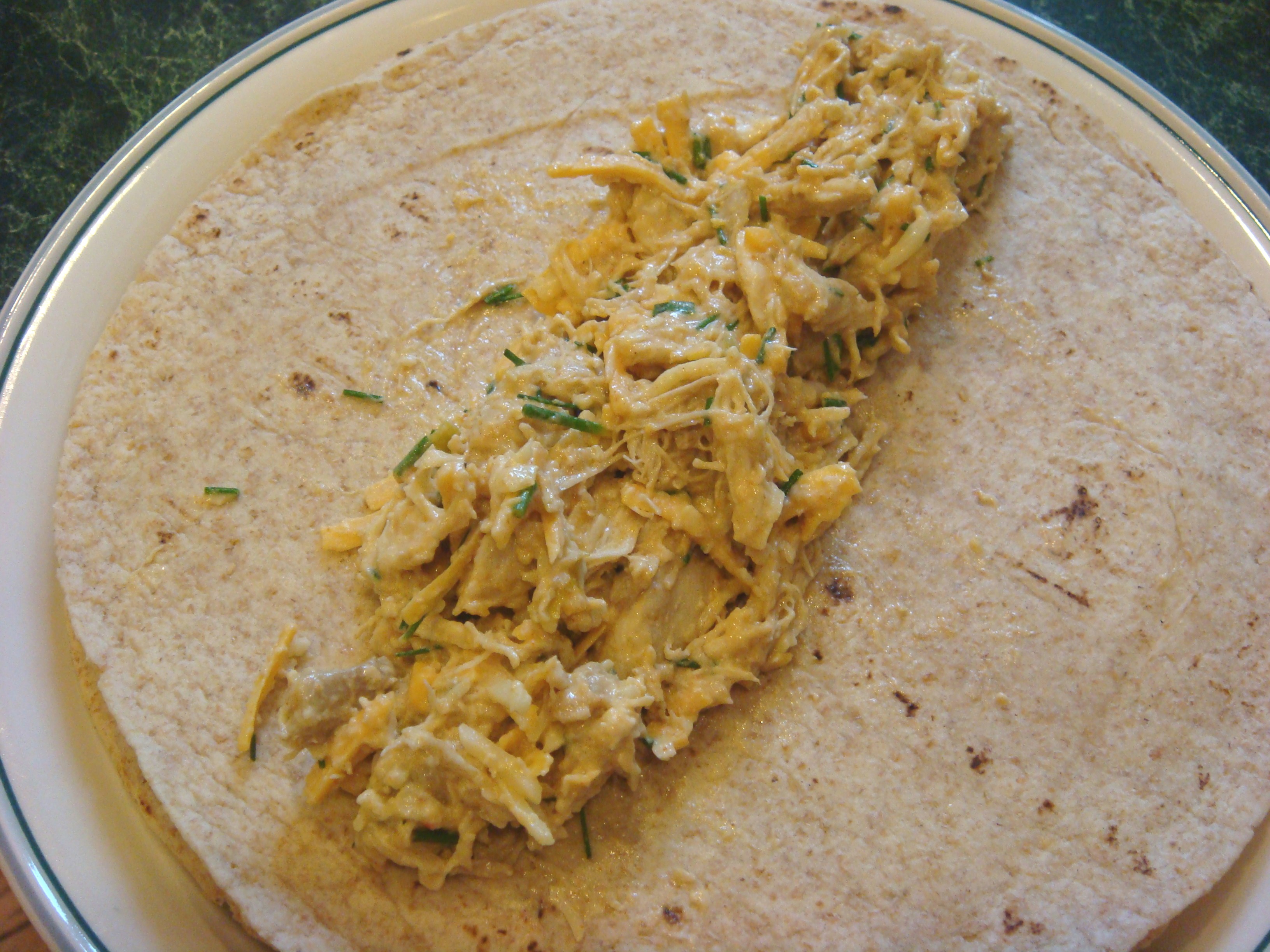
The filling is a simple mix of shredded chicken, cheese, taco seasoning, green onions or chives (one of the few things still growing in my garden) and some of the sauce that also gets spread on top.

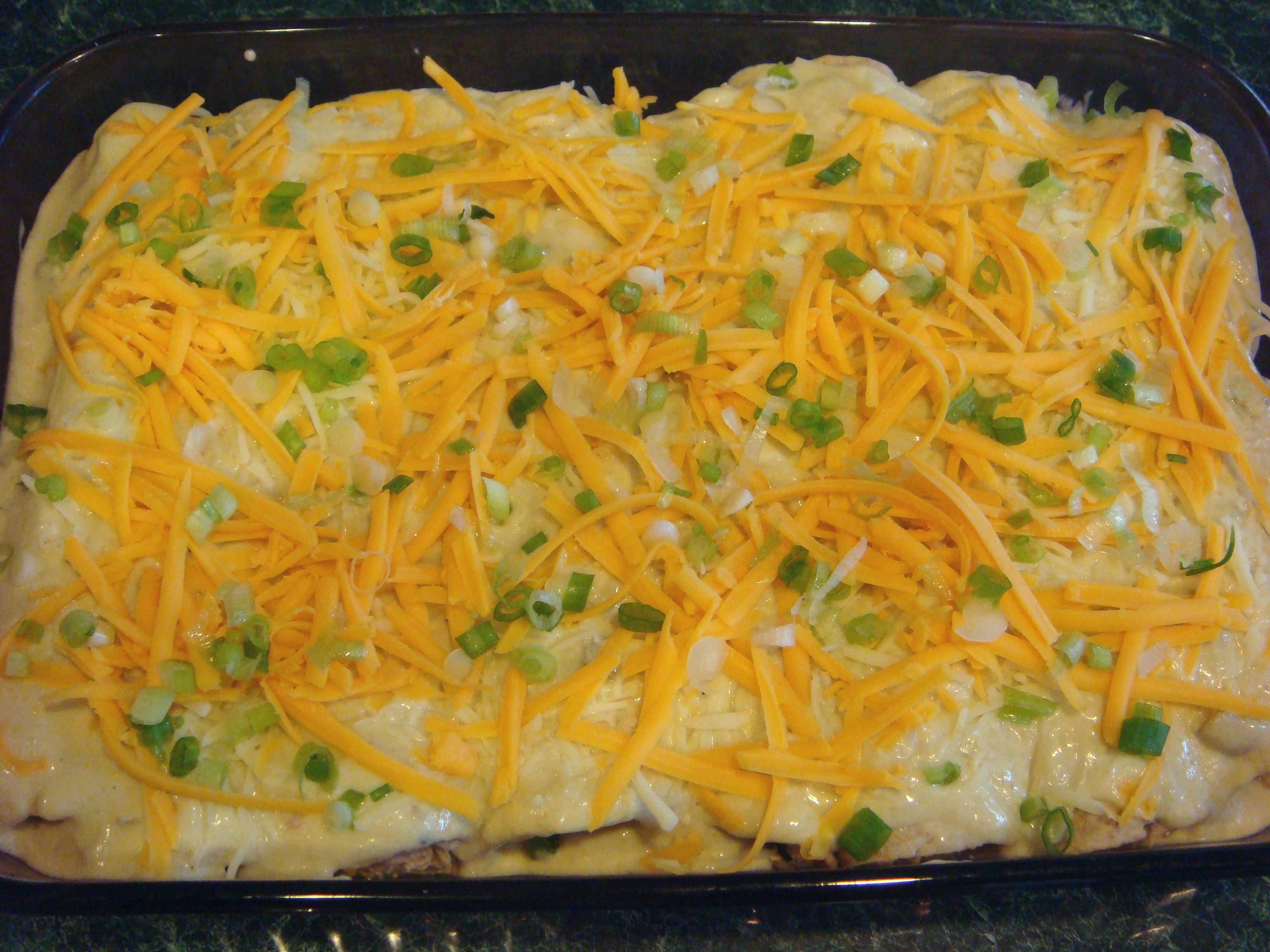
The sauce for these enchiladas is made from a mixture of prepared Green Enchilada Sauce (in the big cans), cream cheese and canned diced green chilies. I could eat it with a spoon!

Then topped with additional cheese (can there ever be enough?) and green onions.

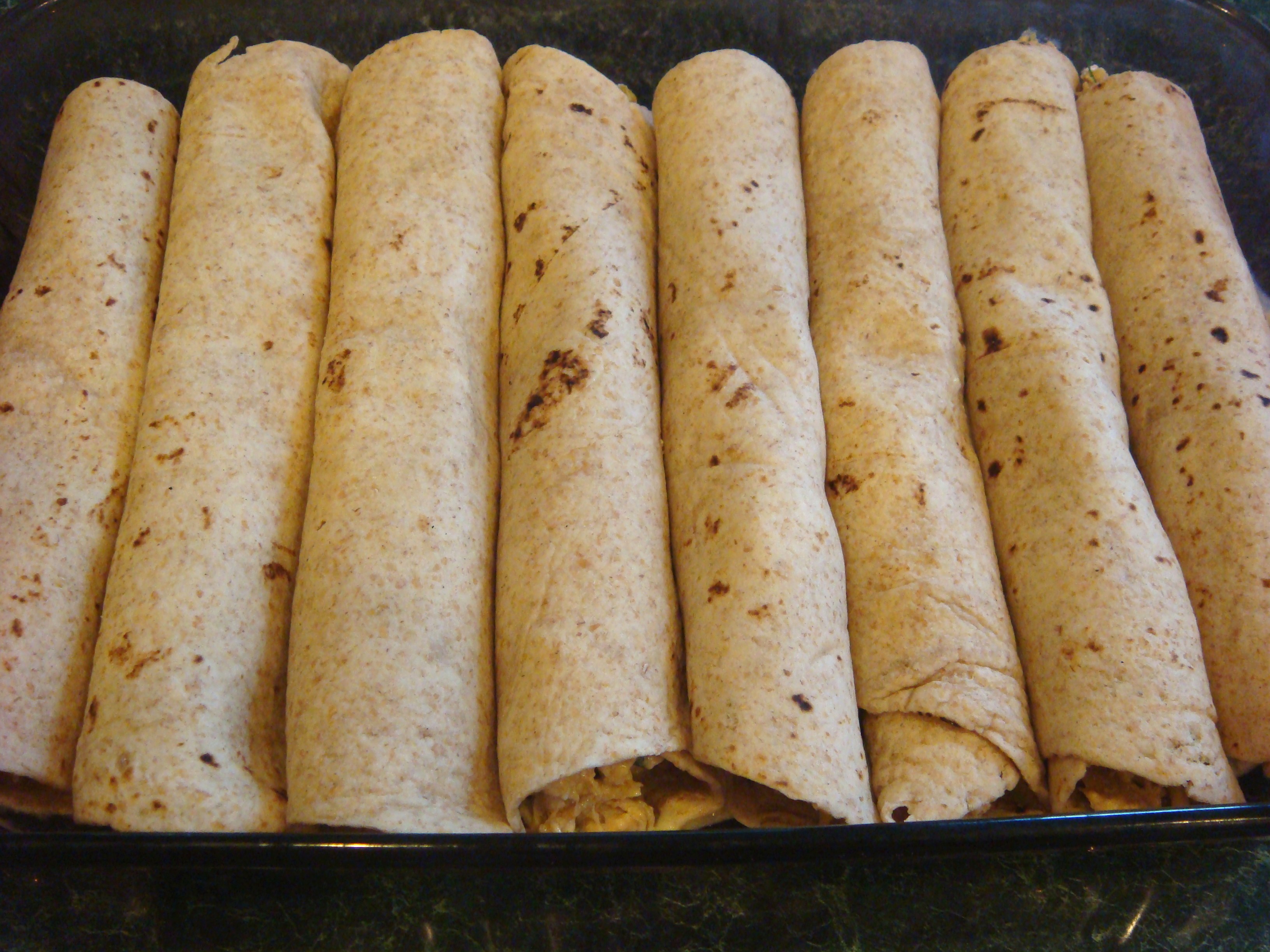
This is also a great freezer meal once it is prepared. To prepare this for a freezer meal, I usually double or triple the recipe (one for tonight, one/two for meals later), and roll the chicken filling in the tortillas. Line a baking sheet with foil or waxed paper and place the filled enchiladas on the pan, being careful not to let them touch. Freeze for several hours, until solid, then put the frozen enchiladas into a Ziploc bag. The sauce can be frozen separately in several smaller bags. Then you can pull out as many pre-made enchiladas as you need for dinner: you are not committed to a whole 9×13” pan. They can be cooked frozen (thaw sauce); just increase initial cooking time to about 1 hour.

RECIPE:

Creamy Chicken Enchiladas Verdes

5 cups cooked and shredded chicken (about 4-6 breasts)
2 Tbs taco seasoning mix
¼ cup chopped green onions or fresh chives
2 ½ cups shredded cheese (cheddar, Monterey Jack and/or mozzarella), divided
28 oz can green enchilada sauce
8 oz cream cheese, softened
4  oz can chopped green chilies
Flour or corn tortillas (about 8 large)
2-3 green onions, chopped

Preheat oven to 375°F.

Combine cooked chicken, taco seasoning, 1/4 cup chopped green onions or chives, and 1 ½ cups shredded cheese. Using a mixer/blender/immersion blender, mix green enchilada sauce, and cream cheese until no lumps remain. Stir in canned chilies. Add about 1 ½ cups of the creamy sauce to the chicken; mix well.

Pour a small amount of sauce into the bottom of a 9×13” baking pan. Roll chicken filling in tortillas. Place enchiladas in pan. Pour remaining sauce over enchiladas. Sprinkle with remaining 1 cup cheese and chopped green onions. Cover and bake for 35-45 minutes, or until hot and bubbly. Uncover and bake 10 minutes longer.

If desired, serve with Roasted Green Tomato Salsa

NoEmptyChairs.me

4 Comments

Filed under Main Dishes

Homemade Pita Bread

Pita bread is an easy bread to make, even for bread-making beginners. If you use instant yeast, you don’t even need to let the dough rise before rolling and baking it. Just a short 10 minute rest, and you are ready to bake!

I use a rectangular pizza stone to bake mine, but you can also use a regular baking sheet or cook them in a small skillet on the stove.

I use a pastry cloth (really just a well-used piece of plain canvas) dusted with flour to roll out my pitas. Once you get the hang of it, you can roll out one or two pitas while your other pitas are baking. Just don’t lose track of time. They cook quickly (2 minutes on one side, 1 minute on second side) and you don’t want them to burn. Keep any rolled pita doughs covered until ready to bake.

Terrible lighting and a bad picture; but a great pita! Some day I think I will do a post called, “Bad Pictures. Good Food.” I have plenty of those taking up space on my hard drive!

Cut pitas in half and fill with this Greek Pork with Tzatziki, or anything you want, really. They are great for a summer fresh-from-the-garden-tomato and bacon sandwich.

Or leave pitas whole and break into pieces (or cut into triangles) and serve with tzatziki and/or hummus as an appetizer.

RECIPE:

Pita Bread

2 ½ tsp instant yeast**
1 ½ cups warm water
3 cups flour
1 tsp salt
1 tsp sugar
Additional flour for kneading, if necessary

Combine yeast, water, flour, salt and sugar. Add additional flour if needed to make a soft, but workable dough. Knead until smooth and elastic. Let dough rest for 10 minutes.

If you have a baking stone, place it (ungreased) on a lower rack in oven while preheating (if you are using a regular baking sheet, place it in the oven only 1 min before adding dough). Preheat oven to 500°F.

Divide dough into 12 small balls. Leave in covered bowl. Roll out each ball into a circle about 6-inches across and ¼-inch thick.

Place on hot baking stone (or baking sheet), one or two at a time. Cook 2 minutes, or until dough puffs up. Turn over and cook about 1 minute longer. With spatula, partially flatten pita (don’t completely flatten, or the insides will stick together). Place on a plate and cover with a towel while other pitas are cooking.

Cut in half and fill to eat. Or leave whole and break into pieces (or cut into triangles) served with hummus and/or tzatziki for dipping.

**NOTE: If you are not using instant yeast, combine regular yeast and water; let sit for 5 minutes, until combined and active. Mix in flour, salt and sugar. Knead until smooth and elastic. Cover and let rise for one hour. Roll into balls and proceed as above.

Yield: 12 whole pitas

NoEmptyChairs.me

2 Comments

Filed under Appetizers, Breads

Greek Pork with Tzatziki in Pitas

Sometimes I think that I should be a paid spokesman for Ziploc. More often than not, dinner at my house either starts in a Ziploc bag full of marinade, or ends up in a Ziploc bag in the freezer.

I am not a fan of bland meat. Honestly, I prefer my meat to taste like something other than meat (except for the occasional really good-quality steak, and even then I tend to be a heavy seasoner). Which is probably why I lean towards Asian cooking so often. Soy sauce, ginger and garlic are a great cure for flavorless chicken breasts.

This dinner is not at all Asian, but does start in a Ziploc bag full of strong flavors. Mediterranean cooking is also one of my favorite styles, with heavy use of olive oil, vinegar, oregano, feta cheese. No wimpy flavors here!

These filled pita pockets can be made with chicken or pork, but I prefer pork-either a pork tenderloin or a pork loin. The loin is a little tougher cut of meat, but if you leave it in the marinade long enough (overnight, at least), it will be tender when cooked. The sautéed pork is combined with peppers, onions, feta cheese and tzatziki and can be served in pita bread pockets or on a bed of lettuce for great salad.

RECIPE:

Greek Pork with Tzatziki in Pitas

2-3 lb boneless pork loin or pork tenderloin, cubed
¼ cup olive oil
¼ cup apple cider vinegar
2 Tbs lemon juice
1 Tbs Worcestershire sauce
2 cloves garlic, minced
3 Tbs chopped fresh oregano (or 1 Tbs dried)
1 Tbs chopped fresh thyme (or 1 tsp dried)
1 tsp salt
½ tsp pepper
¼ tsp ground cayenne red pepper

1 sliced Onion and 1 sliced Red Pepper
————— (or 1 bag frozen onions/peppers)
Pita Bread
Feta Cheese, crumbled
Tzatziki

Combine cubed pork with marinade ingredients (next 10 ingredients) in a Ziploc bag. Refrigerate several hours or overnight. Drain pork in a colander. Sauté in a large skillet for 5 minutes; drain any excess liquid. Cook 10 minutes longer, or until pork is cooked through and nicely brown. Add peppers and onions to skillet; cook until tender.

Serve pork in pita bread halves with feta cheese and tzatziki.

OPTIONAL SERVING VARIATION: Serve cooked pork, onions, and peppers on a bed of Romaine lettuce, topped with the tzatziki and feta cheese.

—–

Tzatziki

1 32-oz container plain yogurt (not nonfat) **
½ of a large seedless cucumber
salt
2 Tbs olive oil
2 Tbs lemon juice
4-6 cloves garlic, crushed
1 tsp dill
Dash white pepper

Line a colander with cheesecloth (or a coffee filter) and place over a bowl. Strain yogurt in cheesecloth in refrigerator for several hours (or overnight) until very thick. Grate cucumber (unpeeled), sprinkle with salt and drain in colander until most of the liquid is removed. Combine yogurt and cucumber with remaining ingredients. Add additional salt (usually about ½ tsp) to taste. Refrigerate several hours to blend flavors.

**You can substitute Greek Yogurt (about 16 oz) for the regular yogurt, and skip the straining process

NoEmptyChairs.me

While you can always use pre-made, tomorrow I will share my recipe for homemade pita bread. They really make a huge difference, and are not difficult to make.

2 Comments

Filed under Appetizers, Breads, Condiments/Sauces, Main Dishes, Salads

How To . . . Roast Garlic

Roasted garlic adds a wonderful flavor to many dishes: salsa, steamed or roasted vegetables, grilled meats, soups & stews, pastas, mashed potatoes, garlic bread.

Roasting garlic is easy to do (much easier than peeling raw cloves), and can be done with either whole heads of garlic, or individual garlic cloves.

For Whole Garlic Heads:

Using a knife, cut off  the top of the head of garlic (about 1/4 to 1/2 inch), just enough to expose the individual cloves of garlic.

Place garlic head on a square of aluminum foil (Large enough to wrap around garlic head). Drizzle each cut garlic head with about 1 Tbs olive oil.

Wrap foil around garlic head and place on a baking sheet. If you are doing a large number of garlic heads at the same time, you could also line a rimmed baking sheet with foil, place garlic heads in the pan and then cover the entire pan with foil, instead of wrapping each garlic head.

Bake at 400°F for 30-40 minutes. The garlic cloves should be soft and slightly browned.

Remove foil, and let the garlic cool slightly. Use the tip of a knife to remove garlic cloves from skins. If the cloves are soft enough, you can also gently squeeze the individual cloves out of the skin of the garlic head.

Empty garlic skin

For Individual Garlic Cloves:

I like to use fresh garlic, but do not like peeling it, and I’m not always a good judge of how many heads to buy for the week. So I buy peeled fresh garlic cloves in 3 lb bags from Costco or Sam’s Club (in the refrigerated produce section):

I definitely can’t use this much garlic before it goes bad, and it really makes the refrigerator reek of garlic. Unless you freeze the whole bag! This has been a perfect solution for me. I throw the entire bag in the freezer (before ever opening it), and then pull out as many cloves as I need for a recipe. They thaw quickly just at room temperature, but you can also microwave them in a small bowl for about 10 seconds, if time is short. No more peeling garlic!

These cloves also work perfectly for roasting.

Place as many cloves of garlic as you want to roast in a small foil-lined oven safe bowl (like a ramekin).  Drizzle with olive oil (about 1 Tbs for 10-15 cloves) and wrap foil around cloves.

Bake at 400°F for 30-40 minutes. The garlic cloves should be soft and slightly browned.

To roast large quantities of garlic, use a larger baking dish or roasting pan. Drizzle garlic generously with olive oil, cover with foil and bake at 400°F. After 30 minutes, remove foil and stir. When you are roasting large amounts of garlic, it may take an additional 20-30 minutes until they are browned.

I roast large quantities of garlic at a time (on a day I can leave the windows open), then freeze it in several 1 cup containers. I always have one container in the refrigerator to use whenever a recipe calls for garlic.

How To Roast Fresh Garlic


For Whole Garlic Heads:

Using a knife, cut off  the top of the head of garlic (about 1/4 to 1/2 inch), just enough to expose the individual cloves of garlic.

Place garlic head on a square of aluminum foil (Large enough to wrap around garlic head). Drizzle each cut garlic head with about 1 Tbs olive oil.

Wrap foil around garlic head and place on a baking sheet. If you are doing a large number of garlic heads at the same time, you could also line a rimmed baking sheet with foil, place garlic heads in the pan and then cover the entire pan with foil, instead of wrapping each garlic head.

Bake at 400°F for 30-40 minutes. The garlic cloves should be soft and slightly browned.

Remove foil, and let the garlic cool slightly. Use the tip of a knife to remove garlic cloves from skins. If the cloves are soft enough, you can also gently squeeze the individual cloves out of the skin of the garlic head.

For Individual Garlic Cloves:

Place as many cloves of garlic as you want to roast in a small foil-lined oven safe bowl (like a ramekin).  Drizzle with olive oil (about 1 Tbs for 10-15 cloves) and wrap foil around cloves.

Bake at 400°F for 30-40 minutes. The garlic cloves should be soft and slightly browned.

To roast large quantities of garlic, use a larger baking dish or roasting pan. Drizzle garlic generously with olive oil, cover with foil and bake at 400°F. After 30 minutes, remove foil and stir. When you are roasting large amounts of garlic, it may take an additional 20-30 minutes until they are browned.

NoEmptyChairs.me

1 Comment

Filed under Appetizers, Canning/Freezing, Condiments/Sauces, Tips and Tutorials